Skip to content

Halo Distortion / Sustainer

Based On
EHX® Big Muff Pi
Effect Type
Distortion / Sustainer, Fuzz
Build Difficulty
Easy
Project Summary
One of the most classic guitar effects of all time, its sound falls somewhere between a distortion effect and a fuzz with an incredibly long sustain.

Complete Kit

What's included?
PCB, finished enclosure, hardware,
and all electronic components.
In stock

$84.00

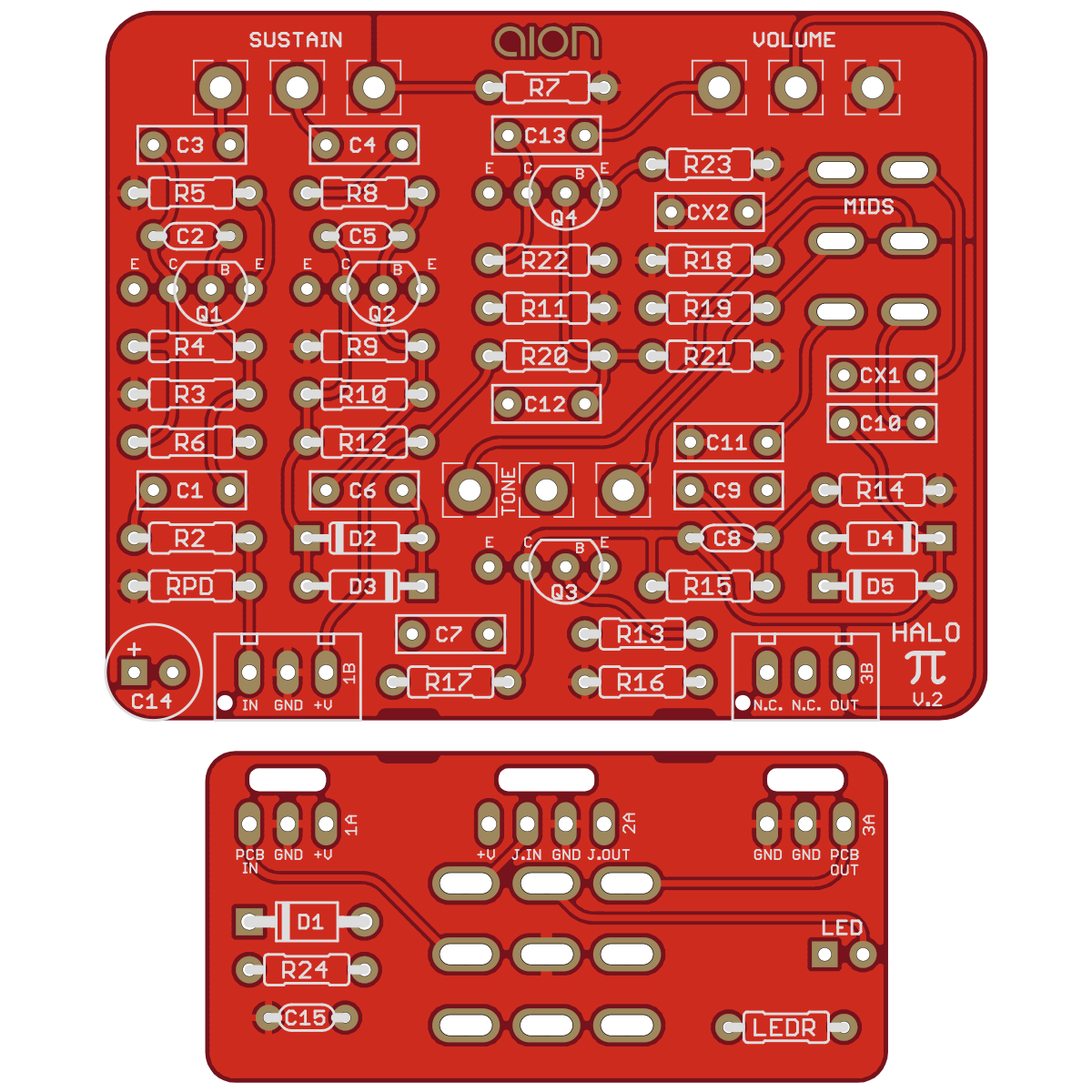
Halo Distortion / Sustainer printed circuit board

PCB Only

What's included?
Just the PCB. Build instructions and parts list can be viewed or downloaded from this page.

$12.50

In stock

In stock

Project overview

The Halo Distortion/Sustainer is a recreation of the Electro-Harmonix Big Muff Pi, first released in 1969. Originally marketed as a “harmonic distortion sustain”, it has been lumped together with fuzz effects, although it’s a very different animal than classic fuzz effects like a Fuzz Face or a Tone Bender.

While the overall circuit has barely changed in 50+ years, Electro-Harmonix was notorious for changing the part values on a whim without advertising the new versions as being different than previous ones. There are around 20 notable variants and many more minor variations within those, with nearly every part in the circuit being tweaked at some point or another.

The Big Muff is a very easy build and there aren’t a lot of things that can be messed up. The transistors don’t need to be biased or sorted by gain, and there are no rare or specialized parts. It’s endlessly tweakable, and you can replicate dozens of different variants by substituting a few parts. For this reason, it’s one of the most popular builds in the DIY community, and has become something of a rite of passage for those getting into the hobby. It’s also a great way to experiment and learn how simple audio circuits work because almost any part substitution will have an audible effect.

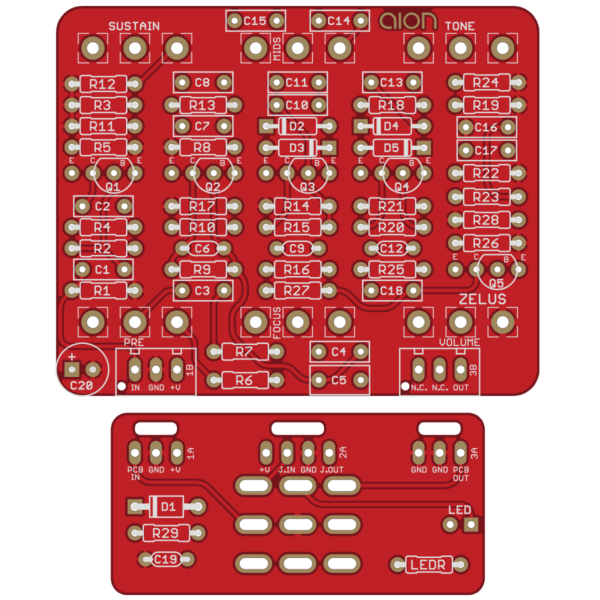
The Halo project is a faithful recreation of the Big Muff, allowing any standard variant to be built. The kit is available in the four most popular versions: Triangle, Violet Ram’s Head, Gilmour, and Civil War. Each of these is described in the “Kit Variants” section below, or on page 10 of the kit build document.

If you’re sourcing your own parts, we created a versions spreadsheet that compiles all the notable variants so you can easily see which parts to substitute for any of them.

The Halo project includes one modification to the original circuit: a midrange switch that allows for the stock mid-scoop tone, a flat midrange response, or boosted midrange. In the mid-scoop setting, it’s 100% identical to the Big Muff circuit, but the switch allows two extra modes if you find that it’s getting lost in the mix.

Demo Video

Check out RJ Ronquillo’s demo video of the Halo Distortion / Sustainer.
Watch on YouTube →

Kit variants

The Big Muff circuit has been in production for over 50 years, and during that time it has undergone many significant changes. Several versions have become classics in their own rights, and there is no “best” or definitive version of the circuit.

Accordingly, our kit is split into variants that cover the four most notable Big Muff versions: Triangle, Violet Ram’s Head, Gilmour, and Civil War. These have traditionally been given nicknames according to their cosmetic appearance, except the Gilmour which is a particular Ram’s Head that was used by the guitarist.

The kit variants differ only in the resistors, transistors, and a small number of non-polarized capacitors. The diodes, potentiometers, switches, and hardware are the same across all versions, and the rest of the build instructions are the same.

Each type of kit uses a different colored bag for the resistors & capacitors, listed with the variant below.

Triangle (1971)

This was the first mass-produced version of the Big Muff, nicknamed the “Triangle” because the three controls were arranged in a triangular shape, as opposed to the later designs where they were all in a line. Since it was the first version, it’s usually the benchmark by which the other versions are described, meaning it has a balanced gain & EQ and a gentle midrange scoop. This variant uses a yellow bag.

Violet Ram’s Head (1973)

Compared to the Triangle, it has a more pronounced mid-scoop and exceptional sustain. It has a distinctive ram’s head graphic in the lower-right corner of the enclosure, and in the most famous version, the enclosure is screenprinted in violet ink. This variant uses a purple bag.

Gilmour (1974)

A red and black Ram’s Head that David Gilmour has used since the mid-1970s. It has several small circuit differences from the Violet Ram’s Head, but the most notable tonal characteristics are a slight cut to the low mids along with reduced gain in the two clipping stages. This variant uses a pink bag.

Civil War (1991)

Produced throughout the 1990s in post-Soviet Russia, favored by bassists due to the increased low-end emphasis and slightly reduced gain. Also called the Green Russian or Red Army, which were identical circuits in different enclosures. This variant uses a green bag.